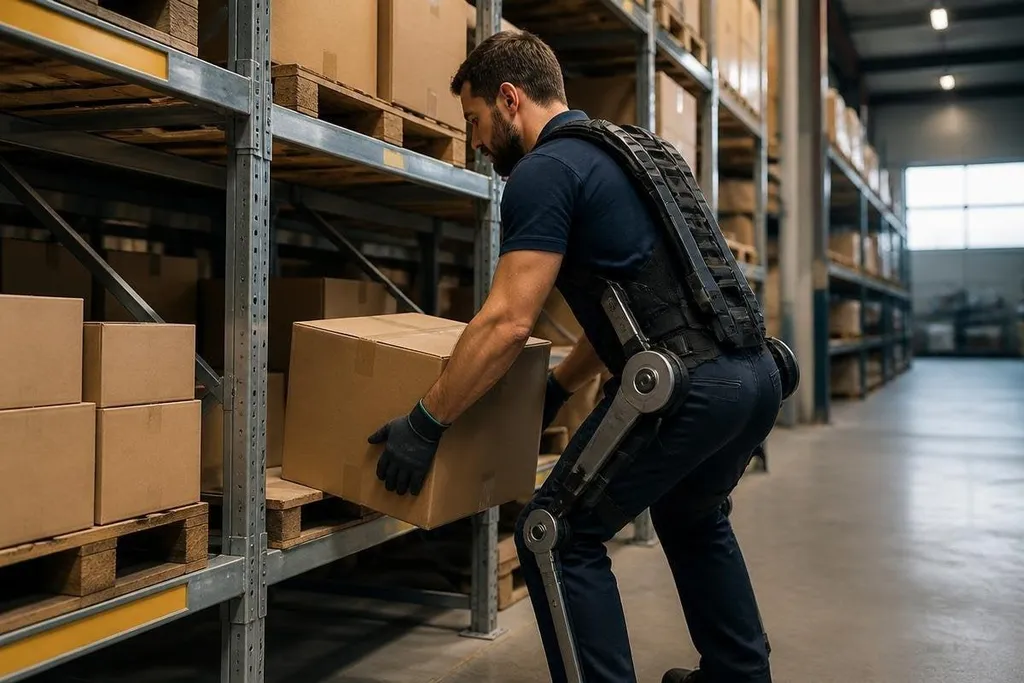
A robotic exoskeleton adds motors, sensors, or springs around parts of the body to help with lifting, walking, or holding a posture. The same frame can lower strain in one task and create new problems if its joints, controls, or load path do not match the person using it.
Quick read
- Powered joints can assist the hips, knees, shoulders, or back during repeated work.
- Fit, balance, battery life, and emergency release affect safe use.
- A trial on the real task matters more than a smooth demonstration.
Where the help comes from
An exoskeleton works by changing how force moves between the person and the task. A passive frame uses springs or mechanical supports. A powered model adds motors, batteries, and sensors that detect movement and add torque, the turning force at a joint.
That help can matter during repeated lifting, overhead work, walking support, or rehabilitation. A hip motor may assist when the wearer rises from a crouch. A shoulder frame may hold part of an arm’s weight while a technician works above head height.
The benefit depends on the task. Assistance at one joint can shift force to another part of the body, so lower back relief may come with more load at the legs, hips, or feet.
Timing matters too. The frame must move at the same time as the wearer. A delay or unwanted motor force can make a normal step feel awkward.
What the worker gains
The main reason to test an exoskeleton is to make a hard task easier to repeat. Lower physical effort may help a person maintain a posture for longer, though that does not prove the worker can safely lift a heavier object or work for a longer shift.
A frame can also keep a load path close to the body. That matters when a person handles tools or parts in a fixed work area, where the same motion happens many times. In rehabilitation, the device may help guide a leg or support walking while a clinician sets the level of assistance.
These gains come with a trade. It adds weight, limits some movement, and can make stairs, tight spaces, seats, or vehicles harder to use. A worker who moves between several tasks may spend more time adjusting the device than gaining from it.
A named model and test setting matter before you judge whether added support helps in practice. Robot24.com exoskeleton reporting can show the task, load, and measured result behind a claim before the next section examines where the device creates new risks.
Where the risks begin
Poor fit is the first concern. Its hip, knee, or shoulder joint needs to sit near the wearer’s own joint. A mismatch can press on soft tissue or resist natural movement. Straps and pads can also create pressure during a long shift.
Control errors add another risk. Sensors may read a crouch, turn, or reach incorrectly. The motor can then add force at the wrong moment. A powered frame needs a clear stop method that the wearer can reach, plus a plan for a low battery, a fault, or a fall.
The work area matters too. Cables, steps, ladders, narrow aisles, heat, dust, and water can change how the frame behaves. A device that works beside a clean workbench may be a poor fit for a construction site or a warehouse route.
Training cannot remove these limits. It can teach fitting, startup, shutdown, charging, and safe movement. It cannot make a frame suitable for a task that its joints or load rating do not support.
Check the task before buying
Use this short decision guide before a purchase or pilot:
- Name the motion: record the lift, reach, walk, or posture the frame should assist.
- Match the joint: check that the device supports the body area that takes the load.
- Test the full route: include stairs, turns, doorways, tools, and the actual work surface.
- Check the failure plan: confirm the stop control, battery warning, fault response, and removal method.
- Measure the result: compare effort, task time, errors, and discomfort with and without the frame.
- Set a review point: ask the wearer and supervisor to report pressure, restricted movement, and new strain.
A trial should use the real worker, real tools, and normal work pace. Short sessions can reveal fit problems, but they cannot show how the device feels after repeated use. The decision should rest on the task record, not on whether the frame looks smooth in a demonstration.
I'd skip any purchase that cannot show where its assistance goes, how the wearer stops it, and what happens when the battery or sensor fails. The useful next step is a supervised trial that measures the task before the device enters daily work.